
Can a glove that tears be more safe? Absolutely – when it tears at the right time and in the right place. This is precisely what uvex safety gloves with patented TearOff technology, such as the uvex phynomic D X HV, do. Read on to find out which applications this model is particularly suited to and what else sets it apart.
There are moments when giving in is the better option. Wise people know this and act on it, because the alternative would be worse. And sometimes things and materials work in exactly the same way: we’re talking about predetermined breaking points. The only reason a car’s airbag can inflate to save a life in a fraction of a second is because clever engineers have incorporated structures into the dashboard and steering wheel that allow this to happen.
Predetermined breaking points ensure safety; uvex safety also followed this simple logic when developing a new safety glove that once again underlines the German PPE manufacturer’s high level of innovation: The uvex phynomic D X HV not only offers cut protection level D, but also features integrated predetermined breaking points on the fingers of the glove.
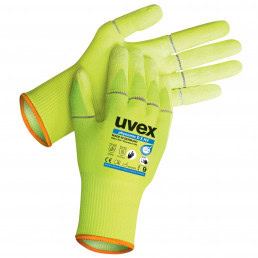
This means that if too much force is applied, the structure gives way and the glove fingers tear off. This prevents the entire glove from becoming caught in the tool when working with hand-held screwdrivers or rotating parts – and significantly reduces the risk of injury. The glove thus offers double protection, particularly when assembling sharp-edged parts: the textile material made of high-performance polyethylene (HPPE) and steel ensures first-class cut protection, whilst the glove fingers, which tear away in an emergency, ensure maximum safety when handling rotating tools.
Patented technology
uvex relies on its proprietary patented TearOff technology. In the uvex phynomic D X HV, this reduces tear forces by 85 per cent compared to conventional cut protection gloves with Cut Level D. This is measured using an tensile testing machine, into which the glove is clamped. Increasing tensile forces are then applied to the structure until it yields. The fingers of the glove eventually tear off at specific points, and the forces of the tensile testing machine are subsequently applied to nothing.
It all starts with the risk assessment
It is interesting to note that defined tear-off points in safety gloves have not yet been described in any specific standard. The key glove standard EN 388 tests cut, puncture, abrasion and tear resistance – but always with the aim of determining the highest possible resistance values in the palm. Technologies designed to yield deliberately at a defined point therefore do not readily fit into existing test procedures.
This also provides a new perspective for safety engineers in companies. As the protective mechanism is achieved not primarily through higher strength values but through a defined degree of give, risk assessment and consultation with the employers’ liability insurance association play an even greater role. They must precisely assess whether the use of adaptive safety technology makes sense in the respective process.
Assembly glove with sensitivity
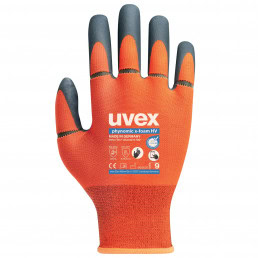
The uvex phynomic D X HV model is the second in the uvex range to feature this integrated emergency exit and the first to offer cut protection of this calibre. The tried-and-tested uvex phynomic x-foam HV assembly glove has been available for some time now and is also equipped with TearOff technology. It is ideal for tasks requiring fine dexterity because it fits like a second skin and is particularly light and flexible – without making your hands sweat straight away.
The product was originally developed in close consultation with major customers whose employees frequently use hand-held screwdrivers on the assembly line. The ability to respond specifically to customers’ needs and thus develop genuine solutions sets uvex apart, and in particular the company’s own Centre of Excellence and Technology Centre for Hand Protection in Lüneburg, northern Germany. Research and development, in-house laboratories and highly flexible manufacturing are all brought together at this single site.
All of this provides extremely fertile ground for innovations, as exemplified by the new cut-resistant safety glove uvex phynomic D X HV: in addition to the integrated predetermined breaking points and Cut Level D, which protects against injuries when handling sharp-edged parts, the high-visibility signal colour is particularly eye-catching, ensuring good visibility. Furthermore, the glove is touchscreen-compatible and fits ergonomically, whilst the coating is breathable and free from harmful substances.
In short: the uvex phynomic D X HV is the safest cut-resistant glove for rotating tools.
Whether one of our safety gloves with predetermined breaking points is specifically suitable for your intended use must be assessed on a case-by-case basis through a risk assessment. Our expert service team (serviceteam@uvex.de) is always on hand to answer any questions you may have.