Standards and Directives
Of course, based on regulation (EU) 2016/425 on personal protective equipment (PPE) our products meet all the necessary standards, and not just that – we always require that little bit more from our products. This ensures the extra safety that our customers – rightly – expect from us.
EN ISO 20345 – Personal protective equipment, safety shoes
The standard EN ISO 20345 defines both the basic and additional requirements for safety shoes. Footwear in accordance with EN ISO 20345 is intended to protect the wearer from bumps, crushing, falling or rolling objects, from walking into sharp or pointed objects, heat or cold, and hot substances, as well as other risks.
Examples of aspects dealt with in the standard are handling mechanical risks, slip resistance, thermal risks and ergonomic properties. Additional standards relating to individual activities deal with risks in relation to footwear with electrical insulation, for example, and shoes to protect against chemicals, footwear for us in foundries and welding work, etc.
The basic requirements described in EN ISO 20345 include:
- height of the upper
- heel area on boots
- minimum length, pressure and bump impact resistance of the toe cap
- water vapour permeability and water vapour number of the upper
- Slip resistance, outsole thickness and abrasion resistance of the outsole
Safety footwear is divided into different protection classes depending on the requirements fulfilled. The safety footwear in protection class SB fulfil the minimum requirements in accordance with EN ISO 20345. Safety footwear with additional requirements are divided into protection classes S1 to S7 depending in the properties.
Labelling
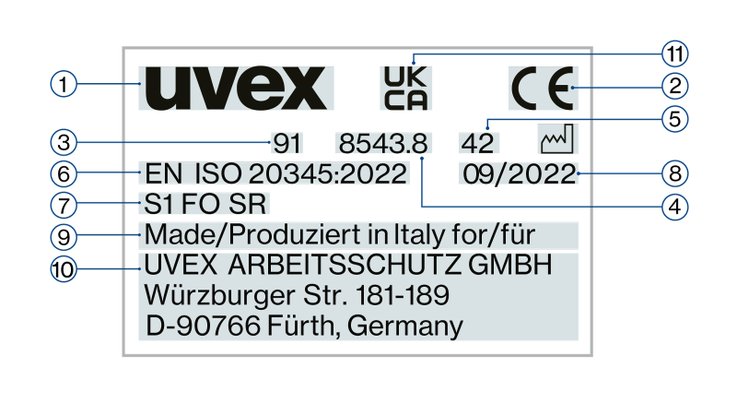
The labelling on the shoe contains the following information:
- Manufacturer
- CE symbol
- Manufacturer’s type designation
- Article number
- Size
- Number of European standard
- Symbol for protection
- Date of manufacture
- Country of Manufacture
- Postal address of the manufacturer
- UKCA symbol
Footwear symbols for industrial usage
| Basic requirements/additional requirements/categories e.g. for leather shoes | Safety footwear EN ISO 20345 | Occupational footwear EN ISO 20347 |
|---|---|---|
| Basic requirements for shoes, slip resistance on ceramic tiles with sodium lauryl sulphate solution, and resistance of the toe cap to impact and compression | SB 200 Joule 15 kilonewtons | OB no requirement |
| Additional requirements: Closed seat region Antistatic properties Energy absorption of seat region | S1 | O1 |
| Additional requirements: as above, plus water penetration and absorption | S2 | O2 |
| Additional requirements: as above, plus Penetration resistance* Cleated outsole | S3 | O3 |
| As for S2, also including water resistance | S6 | O6 |
| As for S3, also including water resistance | S7 | O7 |
| Basic requirements/additional requirements/categories e.g. for polymer shoes made from PVC or PU | ||
| Basic requirements for shoes, slip resistance on ceramic tiles with sodium lauryl sulphate solution, and resistance of the toe cap to impact and compression | SB 200 Joule 15 kilonewtons | OB no requirement |
| Additional requirements: Antistatic properties Energy absorption of seat region Penetration resistance* Cleated outsole | S5 | O5 |
| The choice of a particular shoe depends on the type of occupational risk. As with all footwear, additional requirements may exist (e.g. in terms of heat and cold insulation, penetration resistance or electrical resistance via ESD). These shoes are then marked accordingly. The testing principles for all basic and additional requirements are specified in EN ISO 20344. | ||
| Label | Characteristics tested | Test conditions | Friction coefficient |
|---|---|---|---|
| SRA | Slip resistance on ceramic tile floors with sodium lauryl sulfate solution (SLS) | Forward slip of the heel Forward slip on a flat surface | No less than 0.28 No less than 0.32 |
| SRB | Slip resistance on steel floors with glycerol | Forward slip of the heel Forward slip on a flat surface | No less than 0.13 No less than 0.18 |
| SRC | Slip resistance on ceramic tile floors with sodium lauryl sulfate solution and on steel floors with glycerol | Includes all test conditions cited under a. and b. |
Basic and additional requirements for safety shoes (in accordance with EN ISO 20345:2022, marking S) and occupational shoes (in accordance with EN ISO 20347:2022, marking O)
| Symbol | Requirement | Category | ||||||||||||
|---|---|---|---|---|---|---|---|---|---|---|---|---|---|---|
SB | S1 | S2 | S3 | S3L | S3S | S5 | S6 | S7 | S7L | S7S | O1 | O2 | ||
| - | Basic requirements | x | x | x | x | x | x | x | x | x | x | x | x | x |
| - | Toe cap, tested via 200 joule drop test and 15 kilonewton pressure test | x | x | x | x | x | x | x | x | x | x | x | – | – |
| - | Footwear made of leather or other materials, not including solid rubber or total polymers | o | x | x | x | x | x | – | x | x | x | x | x | x |
| - | Footwear made of solid rubber or total polymers | o | – | – | – | – | – | x | – | – | – | – | – | – |
| - | Slip resistance on ceramic tile floors with SLS | x | x | x | x | x | x | x | x | x | x | x | x | x |
| - | Closed seat region | o | x | x | x | x | x | x | x | x | x | x | x | x |
| A | Antistatic footwear | o | x | x | x | x | x | x | x | x | x | x | x | x |
| E | Energy absorption of seat region | o | x | x | x | x | x | x | x | x | x | x | x | x |
| WPA | Water penetration and absorption of upper material | o | – | x | x | x | x | – | x | x | x | x | – | x |
| WR | Whole shoe waterproof | o | o | o | o | o | o | – | x | x | x | x | o | o |
| P | Perforation resistance, metallic insert | o | o | o | x | – | – | x | o | x | – | – | o | o |
| PL | Perforation resistance, non-metallic insert, tested with a 4.5 mm test nail | o | o | o | – | x | – | – | o | – | x | – | o | o |
| PS | Perforation resistance, non-metallic insert, tested with a 3.0 mm test nail | o | o | o | – | – | x | – | o | – | – | x | o | o |
| - | Treaded sole | o | o | o | x | x | x | x | o | x | x | x | o | o |
x = Requirement must be fulfilled o = Requirement may be fulfilled, but is not mandatory – = Requirement cannot be fulfilled
Additional requirements for special applications
| Symbol | Requirement |
|---|---|
| FO | Fuel resistance and oil resistance |
| SR | Slip resistance on ceramic tile floors with glycerol |
| HI | Heat insulation of the sole complex |
| CI | Cold insulation of the sole complex |
| HRO | Heat resistance of the outsole |
| M | Metatarsal protection |
| AN | Ankle protection |
| CR | Cut resistance of the upper part of the shoe |
| SC | Abrasion resistance of optional overcaps |
| LG | Outsoles provide hold on ladders |
* Penetration resistance
The perforation resistance of the footwear has been measured in a laboratory using standardised nails and forces. Nails with a smaller diameter and higher static or dynamic loads increase the risk of perforation. Under these conditions, additional protective measures should be considered. Three generic types of perforation-resistant insole boards are currently available for PPE footwear. These include types made of metal materials and of non-metallic materials, which must be chosen by means of an activity-based risk assessment. All types offer protection against perforation risks, but each has different additional advantages or disadvantages, including the following:
Metal (P e.g. S1 P, S3):
Is less affected by the shape of the sharp object/hazard (i.e. diameter, geometry, sharpness) due to the processes used in shoe manufacturing, however, it may not be possible to cover the entire bottom of the foot.
Non-metal (PS or PL or category e.g. S1 PS, S3L):
May be lighter and more flexible and may cover a larger area, but perforation resistance may vary more depending on the shape of the sharp object/hazard (i.e. diameter, geometry, sharpness). In terms of the protection obtained, two types are available. Type PS may offer better protection against objects with a smaller diameter than type PL.